HINTS AND TIPS FOR EXHIBITORS – 2025
PREPARATION AND PRESENTATION OF FRUIT
Choose fruit for ripeness, colour, and uniformity.
Apples: should be staged with the eye upwards and stalk down, placing one fruit in the centre and the rest around it. Do not polish the fruit.
Pears and other pear-shaped fruit are best arranged around the perimeter of the plate, stalks pointing towards the centre.
Berries: arrange in rows (except blueberries, which should be arranged around the perimeter of the plate)
Currants: Strings must be attached and look fresh and green. Strings should be roughly parallel. Choose long strings.
Plums, gages, and cherries: must have stalks attached and be careful not to disturb the bloom on the skin. Arrange in lines. Berries and other round fruit can be staged on sand or rice to avoid them rolling around on the plate.

PREPARATION AND PRESENTATION OF VEGETABLES.
Where necessary, vegetables should be washed to remove soil. Use a soft cloth, but never scrub as this may damage the skin. Never use oils to enhance the appearance.
Beans: fresh pods of even colour cut with a portion of stalk remaining. Exhibit with the tail ends facing forward in a line.
Beetroot: select roots of even size about 60-75mm diameter. Small side roots should be removed but avoid specimens that do not have a single small tap root. Trim foliage to 75mm.
Cabbages: solid heads of equal size and a good waxy bloom. Remove only a minimum of outer leaves. Stage with approximately 75mm stalk, heads towards the front.
Cauliflowers and Calabrese: Again, leave 75mm stalk. Just prior to staging, trim back leaves so they match the level of the outside of the curd. Cover the curd with moist cloth or clean paper until the last minute before judging to exclude light.
Courgettes: Select young, tender shapely and uniform fruits approx. 150mm in length and 25-35mm diameter. Stage flat, with or without flowers still attached.
Cucumbers: Fruit should be green and completely matched. The flower end should be completely developed. Aim for 250mm length for indoor grown (less is acceptable for outdoor varieties.
Garlic: Clean off all soil and dry completely. Remove the roots and reduce the stem to 25mm. Don’t divide bulbs into cloves.
Leeks: Uniform size and solid with a uniform blanch that is not bulbous at the base. Avoid excess stripping of outside leaves. Ensure that the stem, leaves, and roots are flushed clean with tap water. Bind in the leaves to an appropriate length.
Lettuce: Lift with roots intact in the evening or early morning when the leaves are turgid/crisp. Wash the
roots and foliage and wrap roots in damp tissue, place in a plastic bag until staging. Remove damaged outer leaves and stage with the hearts pointing forward.
Marrows: Choose tender young uniform fruits, less than 350mm long. For round cultivars 500mm circumference. Wipe clean and stage directly on the bench.
Onions: choose well ripened bulbs of good colour. Do not over-skin. The tops should be neatly tied and the roots cut back to the basal plate. Stage on rings of card or plastic. Shallots should be staged as separate bulbs, not clusters. Cut the roots as with onions and tie the tops. Display on dry sand or similar on a plate.
Peas: Pods should be uniform in length and in good condition. The judges will open the pods to see the peas. Use scissors to cut from the vine with about 25mm stalk and avoid damaging the bloom on the pod by holding the pods with this stalk. Stage on a plate with the tail ends facing front.
Potatoes: Show medium sized specimens 200-250g. wash with a sponge, don’t use a brush as it will damage the skin. Choose potatoes with shallow eyes and free from skin blemishes caused by pests. Stage on a plate with the rose end outwards; cover with a cloth to exclude light until judging commences. N.B. Coloured potatoes are any variety with any colour like King Edwards with pink eyes or can be completely red skinned like Desiree.
Sweetcorn: Cobs of uniform size with fresh green husks should be displayed about one quarter of the grain exposed by pulling down sharply from the tip to the base. The best cobs are filled with straight rows of tender grains. The stalks should be trimmed.
Tomatoes: Fruit should be the right shape, colour, and size for the cultivar. Show with stalks (calyces) still attached. Stage on a plate calyx uppermost. For truss tomatoes cut the truss from the plant carefully as near the main stem as possible. At least a third of the fruit should be ripe.

PREPARATION AND PRESENTATION OF FLOWERS
Cutting: The best time is the evening or early morning. Use a sloping cut to aid water uptake. Remove side shoots, unwanted buds and lower leaves and place upright in a deep container of clean water.
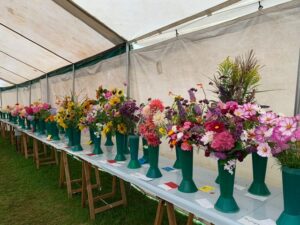
Staging: vases are provided; place stems in the appropriate vase and make sure the stems are not too long nor too short. Blooms should all face the same direction unless all round effect is specified.
Pot plants: the “all round effect” is expected for most pot plants, so keep turning the pot in the preceding days. Remove damaged leaves and faded flowers and stage in a clean container with the best side facing front.
Floral Art: No artificial flowers or foliage allowed, but flowers need not have been grown by the exhibitor for the minimum of two months prior to the show as in other classes. The exhibit should occupy most of the space stated in the schedule.