
September Gardening 2025
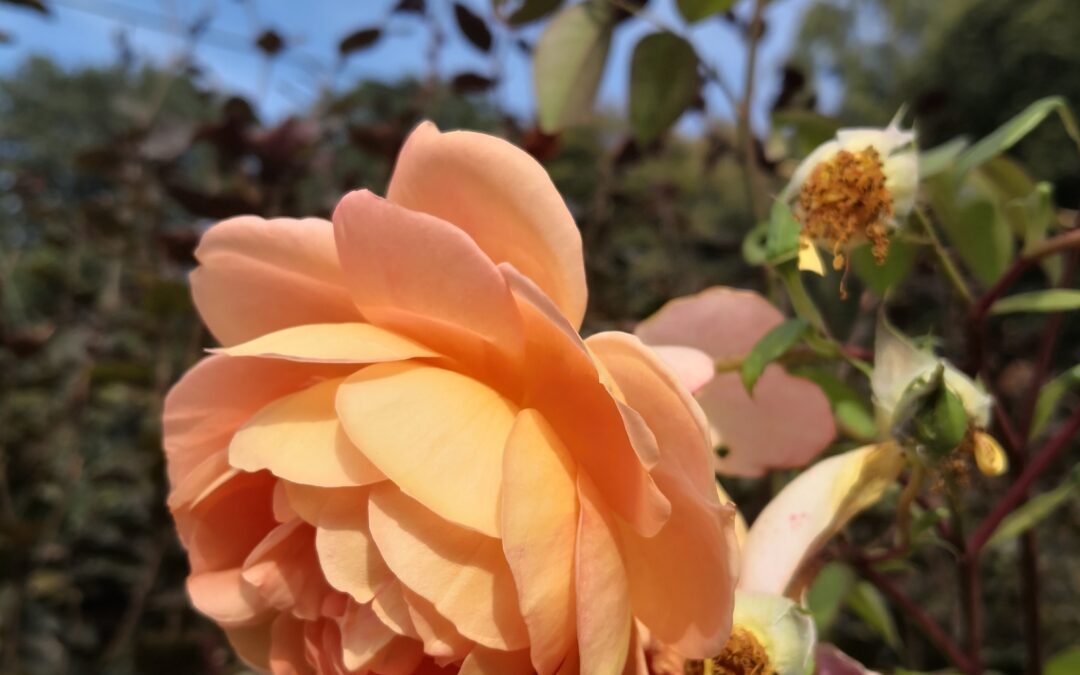
“‘Tis the last rose of summer,
Left blooming alone;
All her lovely companions
Are faded and gone.”
– Thomas Moore, The Last Rose of Summer, 1830
What to do this month
There is still time for weeds to sow seed so continue to hoe or hand weed your borders and beds regularly – the warm wet weather is certainly giving them the right conditions to flourish, just wish my vegetables were as prolific as the weeds…
September is General Tidy Up month in the garden in preparation for winter. Remove any dying leaves, stems and weeds from your borders, long grass can be given one more cut but not too short and net any ponds to prevent leaf fall saving work in the spring.
As nights become cooler birds and other wild life will be preparing for the winter too. Gardeners can help by leaving some seedheads, especially on plants such as teasels, thistles and sunflowers to provide food for birds throughout coldest months. Leaving herbaceous borders intact will provide shelter and warmth for small mammals. Wash bird feeders and tables to maintain hygiene.
THE GREENHOUSE or POLYTUNNEL
If we enjoy an Indian Summer remember to OPEN VENTS and doors on warm days to improve the air circulation. Water earlier in the day to ensure greenhouse is dry by evening to help prevent a fluffy grey mould, Botrytis and damping off of seedlings.
Empty any unused pots or containers, as compost or decaying plant material can harbour unwanted pests over the winter months.
Tomatoes, continue to harvest and prune side shoots as they ripen; bush varieties may stop producing and can be added to the compost heap.
Pick other produce, such as chillies.
Transplant into growing spaces from the seedlings, e.g. chard, cabbage, purple sprouting broccoli
FLOWERS and SHRUBS
Plant spring flowering bulbs narcissi, crocus, hyacinth and muscari between September and October for a colourful spring garden. Tulips are best planted between October and November.
Order trees and shrubs, as they will grow well next spring if planted in the autumn
Roses check for fungal infection such as black spot and remove leaves
Harvest and store summer flower bulbs, lilies, alliums and gladioli
Cuttimg garden, harvest flowers for drying
Divide perennials every 2/3 years to maintain healthy growth and vigour. This can be done year-round but is most successful when the plants are in their dormant season which for most flowering perennials will be September to November.
ROUGH GRASS and MEADOW AREAS
Autumn weather is perfect for good lawn establishment. Rake, aerate nd apply an autumn fertiliser that is rich in potassium and low in nitrogen. Laying a new turf or sowing grass seed now takes advantage of a soil warmed by summer and moist from autumn showers.
Mowing now favours any wild flowers which have seeded over the vigorous grasses; earlier cut favours Spring flowers such as cowslips and fritillaries, later cut knap-weed and self-heal.
VEGETABLES
Now is the time for lifting and storing
Pumpkins and squash can be lifted off the ground to prevent rotting, such as on a piece of wood. To help pumpkins ripen in time for Halloween cut away any leaves shading them. Onions and tomatoes should be left to ripen to ensure they store well through the winter
Beans clear away and compost plants; replace with Spring cabbage seedlings, pak choi, perpetual spinach
Salad leaves, harvest as needed, compost unproductive plants
Potatoes, begin to harvest late crops. Store by drying tubers for a day, turning occasionally in a warm place before storing in hessian bag in a cool dark place
Water the thirsty plants daily, courgettes, squashes, tomatoes
Herbs, leave borage, calendula, coriander, dill, nasturtium in situ to set seed for next year, others can be potted up and kept on sunny window sill or frozen for use over winter
FRUIT
Strawberries, raspberries, and other berry fruits are best planted during their dormant season. Strawberry runners peg down into pots of compost to root new plants, leave attached to mother plant for 4 weeks before severing the runner
SEEDS
Sowing seeds. Sowing in September gives you earlier crops in the Spring such as spinach and broad beans (in shallow drill, cover with fleece /cloche from October) and peas (in doors)
Onions, possible to grow from seed but easier from sets
Winter salads (e.g. coriander, radish, purslane, rocket, winter lettuce, peas for shoots) to plant out in Greenhouse in October. Sow a variety as the leaves grow slowly and sometimes not at all during November and December.
Collecting seeds. Many seeds will be ready to harvest in September. Pick when seed heads are ripe – generally when they turn from green to brown and the seeds have gone hard. The heads need to be as ripe as possible but catch them before they burst.
Choose a fine, dry day and use sharp scissors or secateurs to snip off the seed heads. Place them in a paper bag or envelope to avoid any fungal problems that might arise with a plastic bag or container.
Write the name of the plant onto the bag as they are gathered, as it is easy to mix up seed stocks. Leave the bags in a cool, airy place until sorted through.
Storing seeds Empty the bags of harvested material out onto a sheet of clean, dry newspaper and gently tease apart the chaff with your fingers, until the seed is clean.
Batch them up into small paper envelopes, small brown paper ones are cheaper than white.
Label carefully and store in an airtight container in a cool, frost-free place – the back of the fridge is perfect – until ready to sow.
FLOWER SEEDS, collect seeds from ripening biennials, perennials, and first hardy annuals. The following are easy to sow:
Cornflower
Love- in- the- mist (nigella damascene), short lived annual with showy flowers and decorative seed pods
English or pot marigold (Calendula officinalis), hardy plant with edible flowers
Thorow-wax (Bupleurum rotundifolium), hardy annual with bright green flowers and delicate foliage
Giant larkspur (Consolida ajacis), annual delphinium
Honesty (Lunaria annua), biennial with decorative papery seed discs
Opium Poppies (Papaver somniferum), varieties such as the pale pink double ‘Candy Floss’, inky double ‘Black Beauty’ and purple ‘Lauren’s Grape’ are attractive
Rose campion (Lychnis coronaria), long-blooming silver- grey-leaved perennial for a sunny border
Looking ahead….. order your seed catalogues, if only to look through during the cold Winter evenings. Dobies gives Garden Society members 50% off seeds, a new code is given at end of each October for following year.